The audio for this story is currently not available.
Ke kgang ya Ngede, Mogaka.le monna wa lekau yo o timanang
a bidiwa Gingile. Letsatsi lengwe Gingile a ile go tsoma a utlwa lentswe la ga Ngede. Legano la ga Gingile la tlala mathe a gopotse lomepe. O ne a ema le reetsa sentle, a batlisisa go tsamaya a bona nonyane mo kalengfa godimo ga tlhogo ya gagwe. “Shitik,shitik, shitik,”e bitsa, e tla a khutla fa gare go netefatsa gore Gingile a e sale morago.
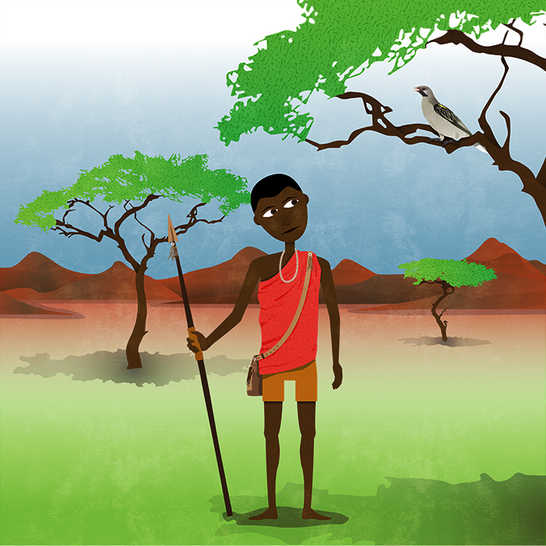
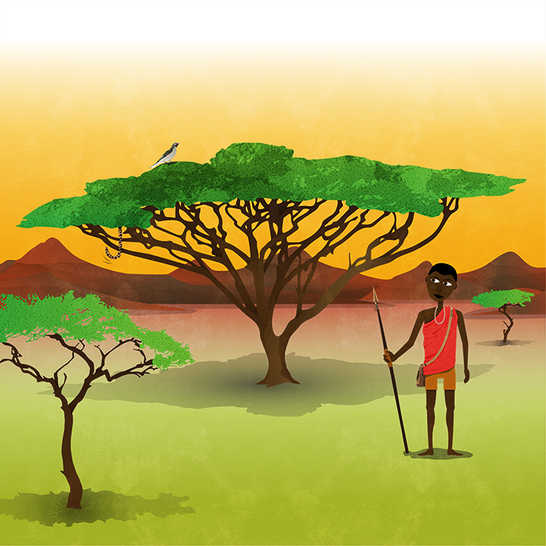
This is the story of Ngede, the Honeyguide, and a greedy young man named Gingile.
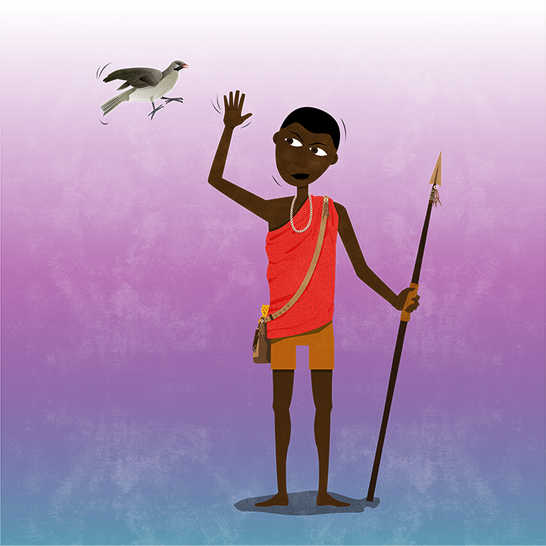
One day while Gingile was out hunting he heard the call of Ngede. Gingile’s mouth began to water at the thought of honey. He stopped and listened carefully, searching until he saw the bird in the branches above his head.
“Chitik-chitik-chitik,” the little bird rattled, as he flew to the next tree, and the next.
“Chitik, chitik, chitik,” he called, stopping from time to time to be sure that Gingile followed.
Voici l’histoire de Ngede l’indicateur et d’un jeune homme avide nommé Gingile. Un jour, lorsqu’il chassait, Gingile entendit l’appel de Ngede. Gingile commença à saliver en pensant au miel. Il s’arrêta et écouta attentivement, fouillant jusqu’à ce qu’il trouve l’oiseau dans les branches au-dessus de sa tête. « Chitik-chitik-chitik, » chantait le petit oiseau, en volant d’un arbre à l’autre. « Chitik-chitik-chitik, » lançait-t-il, s’arrêtant de temps en temps pour s’assurer que Gingile le suivait.
Morago ga ura le halofo, ba fitlhela setlhare feie se se tona.Ngede e ne e tlola tlola jaaka setsenwa mo gare ga dikala.A ye go nna mo kaleng e le ngwe fela a tlhomile tlhofo ya gagwe ko Gingile jaaka e kete e ka re .”Ke a fa!Tla jaanong! O tseelang lobaka lo lo leele jana?”Gingile o ne a sa bone dinotshe dipe ka fa tlase ga setlhare, mme o ne a ikanya Ngede.
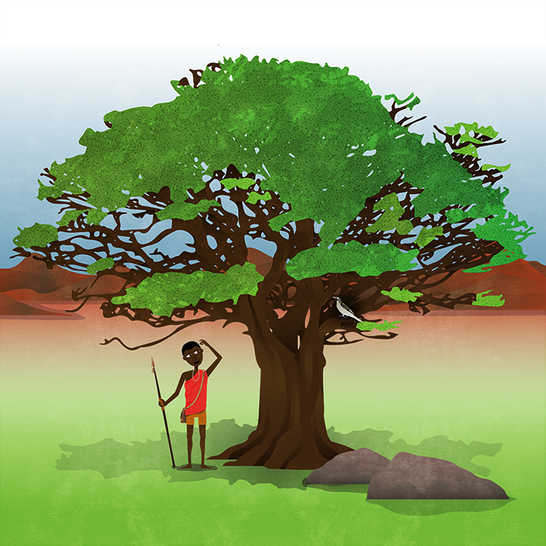
After half an hour, they reached a huge wild fig tree.
Ngede hopped about madly among the branches. He then settled on one branch and cocked his head at Gingile as if to say, “Here it is! Come now! What is taking you so long?”
Gingile couldn’t see any bees from under the tree, but he trusted Ngede.
Après une heure et demie, ils atteignirent un figuier sauvage énorme. Ngede sautilla éperdument parmi les branches. Il s’installa ensuite sur une branche et inclina sa tête vers Gingile comme pour dire, « Le voici ! Viens vite ! Qu’est-ce qui te prend autant de temps ? » Gingile ne pouvait pas voir d’abeilles depuis le dessous de l’arbre, mais il avait confiance en Ngede.
Gingile a baya lerumo ka fa tlase ga setlhare,a kokoanya matlhare a gotsa molelo o monnye.E rile molelo o tuka sentle, a tsenya logong lo lo omileng mo gare ga molelo.Logong lo lo ne lo itsege ka go dira mosi o montsi fa lo tuka. A palama, a tshegeditse logong ka fa ntlheng e e tsididi ka meno a gagwe.
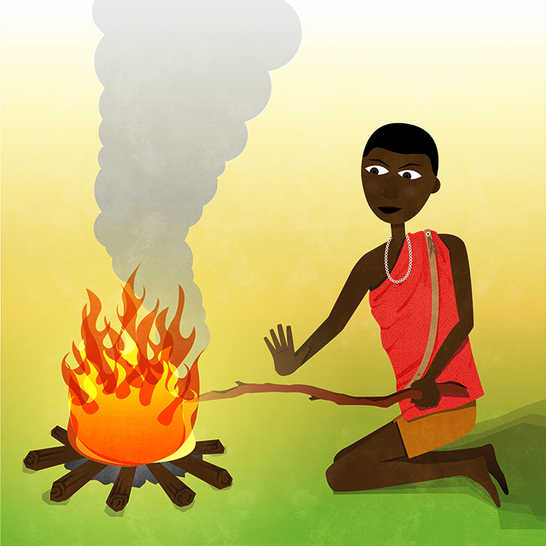
So Gingile put down his hunting spear under the tree, gathered some dry twigs and made a small fire.
When the fire was burning well, he put a long dry stick into the heart of the fire. This wood was especially known to make lots of smoke while it burned.
He began climbing, holding the cool end of the smoking stick in his teeth.
Alors, Gingile déposa sa lance sous l’arbre, recueillit des brindilles séchées et alluma un petit feu. Une fois que le feu brûlait bien, il mit une longue branche au cœur du feu. Ce bois était connu pour la fumée qu’il créait quand il brûlait. Gingile commença à grimper, tenant entre ses dents le bout froid de la branche qui fumait.
ka bonako a utlwa modumo wa dinotshe se di dirang. Di ne di tsena le go tswa mo lehogong la setlhare kgoro ya motshitshi ya jone. Fa Gingile a fitlhelela motshitshi a tsenya logong lo lo kubang mosi mo lehogong. Dinotshe di ne tsa tswa, ka bogale le ka boikaelelo. Di ne tsa fofa tsa tsamaya ka di sa rate mosi - mme pele tsa loma loma Gingile thata.
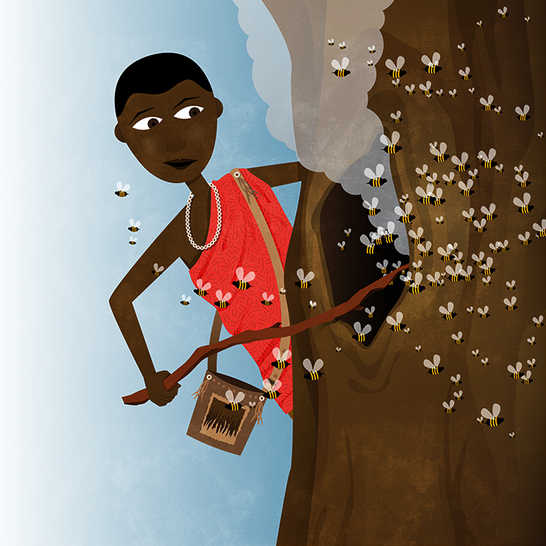
Soon he could hear the loud buzzing of the busy bees. They were coming in and out of a hollow in the tree trunk – their hive.
When Gingile reached the hive he pushed the smoking end of the stick into the hollow.
The bees came rushing out, angry and mean. They flew away because they didn’t like the smoke – but not before they had given Gingile some painful stings!
Bientôt il pouvait entendre le bourdonnement bruyant des abeilles affairées. Elles rentraient et sortaient d’un creux dans le tronc d’arbre - leur ruche. Lorsque Gingile arriva à la ruche il mit le bout fumant de la branche dans le creux. Les abeilles sortirent, fâchées et méchantes. Elles s’envolèrent parce qu’elles n’aimaient pas la fumée - mais pas avant d’avoir piqué douloureusement Gingile !
fa di se na go tswa, Gingile a tsenya mabogo a gagwe mo teng ga setlhaga. A tsaya lomepe seatla se tletse, se ntse se rotha lomepe le mafura, le diboko tse ditshweu. a tsena lomepe mo kgamelong e o ne a itseile, a simolola go phola setlhare.
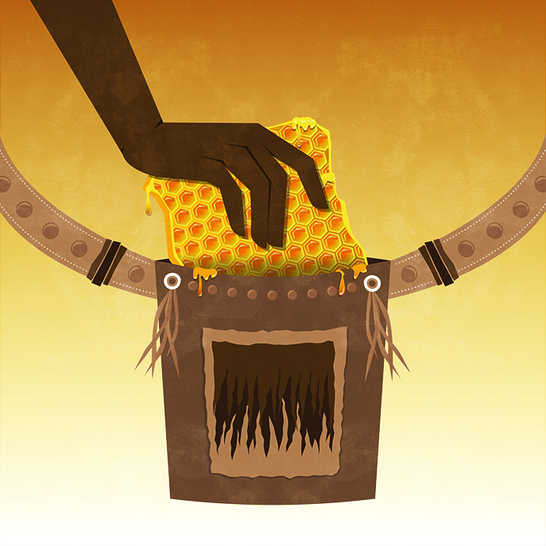
When the bees were out, Gingile pushed his hands into the nest. He took out handfuls of the heavy comb, dripping with rich honey and full of fat, white grubs.
He put the comb carefully in the pouch he carried on his shoulder, and started to climb down the tree.
Quand les abeilles furent sorties, Gingile enfonça ses mains dans le nid. Il sortit des poignées de rayons de miel d’abeilles desquelles s’écoulait du miel riche et des larves grasses et blanches. Il mit soigneusement le nid dans la besace qu’il portait sur son épaule et commença à descendre de l’arbre.
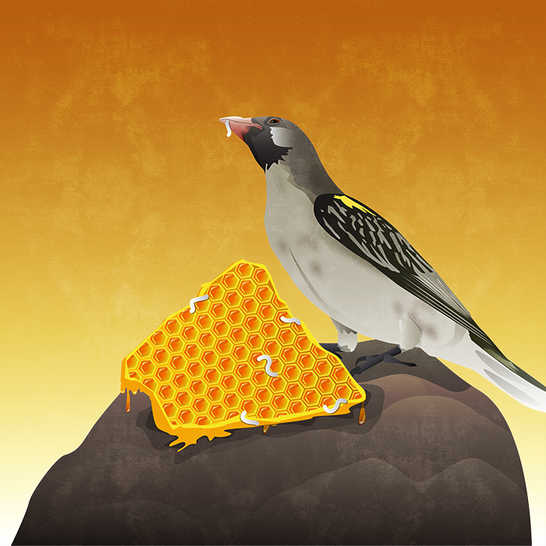
Ndege o ne a lebeletse sengwe le sengwe ka thwaafalo se Gingile a se dirang. O ne a mo letile gore a o tla tlogela sengwenyana sa motshitshi go ka leboga nonyane e e mo kaetseng lomepe. Ngede ya fofa fofa mo dikaleng, go atamelana le mmu. Bofelong Gingile a fitlha kwa tlase ga setlhare.Ngede akwaya mo godimo ga letlapa go bapa le mosimanyana mme a letile tuelo ya gagwe.
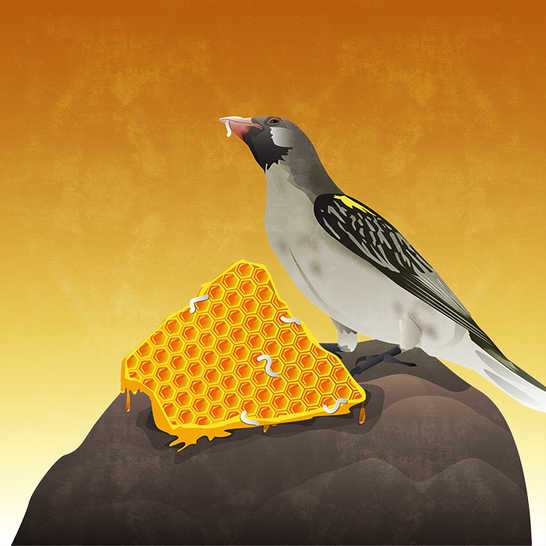
Ngede eagerly watched everything that Gingile was doing. He was waiting for him to leave a fat piece of honeycomb as a thank-you offering to the Honeyguide.
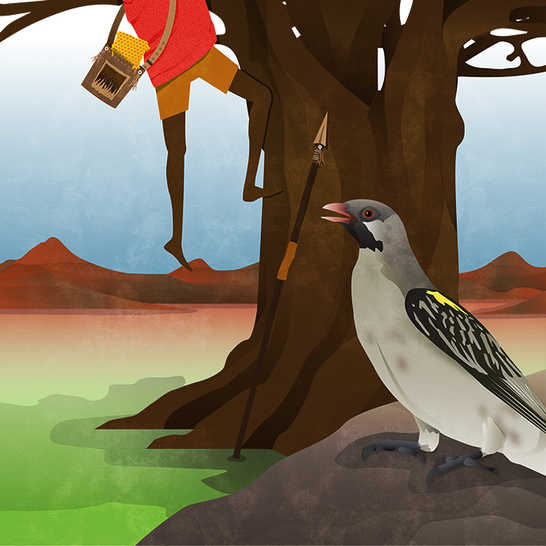
Ngede flittered from branch to branch, closer and closer to the ground. Finally Gingile reached the bottom of the tree.
Ngede perched on a rock near the boy and waited for his reward.
Ngede regardait avec impatience tout ce que Gingile faisait. Il attendait qu’il laisse un gros morceau de nid d’abeille comme signe de remerciement à l’indicateur. Ngede voltigeait de branche en branche, de plus en plus près du sol. Finalement, Gingile arriva au pied de l’arbre. Ngede se percha sur une roche près du garçon et attendit sa récompense.
Mme, Gingile a tima molelo, a tsaya lerumo la gagwe a boela gae, a tlhokomologa nonyane. Ngede a bitsa ka letenego,”VIC_torr!VIC_torr!” Gingile a ema, a gotolela nonyane e nnye matho mme a tshegela kwa godimo. “A o batla lomepe. a o a batla tsala ya me? Ha! Mme ke dirile tiro yotlhe, ka lomiwa ga botlhoko. Ke ka ntlha ya eng ke tshwanetse go kgaogana lomepe lo le wena?”Mme a tsamaya. Ngede o ne a sakgala! E ne e se mokgwa o a ka tsewang ka one!Mme o ka ipusololetsa.
But, Gingile put out the fire, picked up his spear and started walking home, ignoring the bird.
Ngede called out angrily, “VIC-torr! VIC-torrr!”
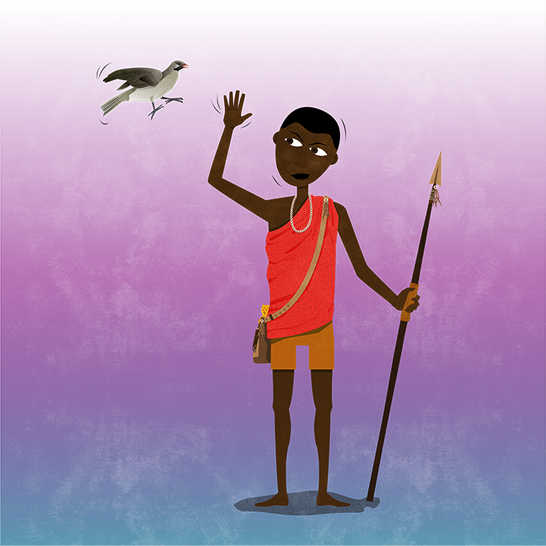
Gingile stopped, stared at the little bird and laughed aloud. “You want some honey, do you, my friend? Ha! But I did all the work, and got all the stings. Why should I share any of this lovely honey with you?” Then he walked off.
Ngede was furious! This was no way to treat him! But he would get his revenge.
Mais Gingile éteint le feu, ramassa sa lance et commença à rentrer chez lui, en ignorant l’oiseau. Ngede lança, fâché, « VIC-torr ! VIC-torr ! » Gingile s’arrêta, dévisagea le petit oiseau et éclata de rire. « Tu veux du miel, mon ami ? Ha ! Mais c’est moi qui ai fait tout le travail et qui me suis fait piquer. Pourquoi est-ce que je devrais partager ce miel avec toi ? » Et il partit. Ngede était furieux ! Ce n’était pas une façon de le traiter ! Mais il aurait sa revanche.
Letsatsi lengwe moraga ga dibeke tse mmalwa Gingile gape a utlwa Ngede a mo biletsa lomepe. A gakologelwa lomepe lo lo monate, ka bogale a latela nonyane gape. Morago ga go gogela Gingile mo sekgweng, Ngede a ema go khutsa ka fa tlase ga setlhare se tona. “Ahh,” ga akanya Gingile.” Motshitshi o tshwanetse o bo o le mo setlhareng se. “Ka bonako a gotsa molelo o monye wa gagwe a simolola go palama setlhare, logong lo lo kubang mosi a le tshegeditse ka meno a gagwe. Ngede o ne a dutse a lebeletse.
One day several weeks later Gingile again heard the honey call of Ngede. He remembered the delicious honey, and eagerly followed the bird once again.
After leading Gingile along the edge of the forest, Ngede stopped to rest in a great umbrella thorn. “Ahh,” thought Gingile. “The hive must be in this tree.” He quickly made his small fire and began to climb, the smoking branch in his teeth. Ngede sat and watched.
Un jour, plusieurs semaines plus tard, Gingile entendit de nouveau l’appel de Ngede. Il se souvint du miel délicieux et suivit avec impatience l’oiseau une fois de plus. Après avoir guidé Gingile à l’orée de la forêt, Ngede s’arrêta pour se reposer dans un acacia épineux. « Ahh, » pensa Gingile. « La ruche doit être dans cet arbre. » Il alluma rapidement son petit feu et commença à grimper, la branche fumante entre ses dents. Ngede s’assit et le regarda.
Gingile o ne a pagama, mme a akgamala gore ke eng a sa utlwe modumo wa dinotshe jaaka gale. Gongwe motshitsho o ko teng ga thata mo setlhareng, a ikakanyetsa. A pagamela kwa kaleng e nngwe. Mme mo boemong jwa motshtshi, o ne a gotolela matlho mo sefatlhogong sa lengau! Lengau le ne le kgotsoile ka le tshwentswe mo borokong la jone. A dira matlho a yone mannye, ya bula legano go bontsha meno a yone a a matona le a bogale thata.
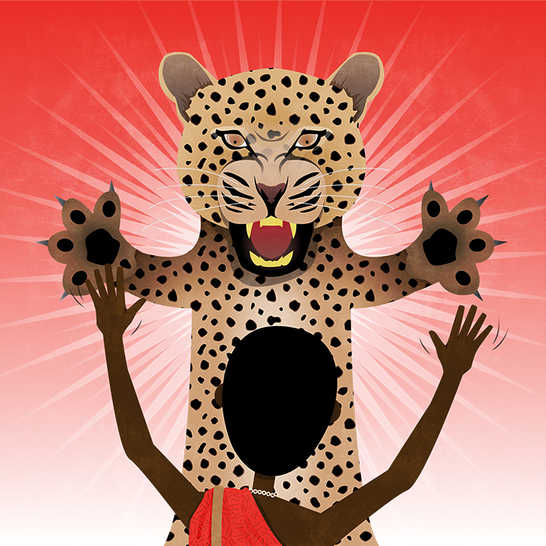
Gingile climbed, wondering why he didn’t hear the usual buzzing. “Perhaps the hive is deep in the tree,” he thought to himself. He pulled himself up another branch. But instead of the hive, he was staring into the face of a leopard!
Leopard was very angry at having her sleep so rudely interrupted. She narrowed her eyes, opened her mouth to reveal her very large and very sharp teeth.
Gingile grimpa, se demandant pourquoi il n’entendait pas le bourdonnement habituel. « Peut-être que la ruche est très profonde dans l’arbre, » se dit-il. Il se hissa sur une autre branche. Mais au lieu de la ruche, il arriva face-à-face avec le visage d’un léopard ! Léopard était très fâchée que son sommeil ait été interrompu si brusquement. Ses yeux se plissèrent et elle ouvrit sa bouche pour révéler ses grandes dents pointues.
Pele lengau le ka moloma,a pagologa ka bonako.Mo go itlhaganeneng ga gagwe a se ka ka gata kala nngwe, a wela fa fatshe a wa maswe a utlwa botlhoko mo legwejaneng. A tsamaya ka bonako a ntse a kotsemela. Lesego la gagwe lengau le ne le sa ntse le tshwere ke boroko la palelwa ke go ke go mo leleka. Ngede, nonyane ya lomepe e ne ya ipusolosetsa.Mme Gingile a ithuta sengwe.
Before Leopard could take a swipe at Gingile, he rushed down the tree.
In his hurry he missed a branch, and landed with a heavy thud on the ground twisting his ankle. He hobbled off as fast as he could. Luckily for him, Leopard was still too sleepy to chase him. Ngede, the Honeyguide, had his revenge.
And Gingile learned his lesson.
Avant que Léopard ne puisse s’en prendre à Gingile, ce dernier se précipita en bas de l’arbre. Dans son empressement, il manqua une branche et atterrit par terre avec un bruit sourd, se tordant la cheville. Heureusement pour lui, Léopard était encore trop endormie pour le poursuivre. Ngede, l’indicateur, eu sa revanche. Et Gingile retint sa leçon.
Mme e rile bana ba ga Gingile ba utlwa kgang e ya ga Ngede ba tlotla le yone nonyane e e nnye. Gongwe le gongwe ko ba batla lomepe gone, ba leka go tlogelela nonyane ya lomepe ,lomepe lo lontsi.
And so, when the children of Gingile hear the story of Ngede they have respect for the little bird. Whenever they harvest honey, they make sure to leave the biggest part of the comb for Honeyguide!
Ainsi, quand les enfants de Gingile entendent l’histoire de Ngede ils respectent le petit oiseau. Chaque fois qu’ils récoltent du miel, ils s’assurent de laisser la plus grande partie du rayon à l’indicateur !